Clock

Friday, November 13, 2015

2015 Honda Civic Type R


Sadly, the Car and Driver time machine was irreparably damaged recently in an attempt to go back to 1982 and uninvent the Cadillac Cimarron. But let’s imagine for a moment it’s still working, and that we can use it to send this brand-new Honda Civic Type R 10 years into the past.

There’s no doubt that the car itself would be a sensation. This is a 300-plus-hp, front-wheel-drive hatchback that’s capable of lapping the Nürburgring Nordschleife in less than eight minutes—and with styling seemingly inspired by the body armor of an Imperial stormtrooper. Yet the R would also have been highly controversial for being turbocharged back when the Honda brand was still practically fetishizing natural aspiration. So the question for 2015 is whether the ends really justify the means.

First we need to make the sad acknowledgement that this is a review of some sweet-tasting forbidden fruit. The Euro-spec Civic Type R won’t be coming to the U.S. soon or ever. But this isn’t just another entry in our continuing series of Awesome Cars that Automakers Deny Us, because Honda will admit that this Type R is dropping some very broad hints about what we can expect from the U.S.-spec version of the next-gen model. Yes, that Type R has already been confirmed for American sale in the near future, and it almost certainly will use the same Ohio-built turbocharged engine.

Bringing us back to the big issue: Is this a good idea? The growing ubiquity of forced induction among small-capacity engines means the idea of a turbocharged Honda isn’t as shocking as it would have been a decade ago, but it still stands out as radically different. Outside Japan, the only turbocharged gasoline engine Honda has ever brought to market was the one fitted to the first-generation Acura RDX. And with so much of the character of earlier Type R models derived from the linearity of their power delivery and their ravenous enthusiasm for revs, the big concern is that this new turbocharged engine is going to be a very blunt weapon in comparison.


The specific output is certainly impressive. A total of 306 horsepower from a 2.0-liter four puts the Civic’s engine just slightly above the brawny, 292-hp version of Volkswagen’s EA888 TSI engine, as fitted to the Audi S3 and the Golf R. Indeed, it practically matches the output of the BMW M235i with two fewer cylinders and 50 percent less displacement. The engine features a small single-scroll turbocharger and a VTEC variable valve-timing system that will overlap exhaust and inlet slightly to reduce turbine lag. Much is made of the engine’s ability to rev to a 7000-rpm redline, with peak power coming online at 6500 rpm, but that ceiling is a full 1000 rpm lower than managed by the last Civic Type R.

The output is shuttled to the front wheels via a standard six-speed manual gearbox—there are no plans for any other transmission option—and a mechanical limited-slip differential. The front suspension struts get separate steering knuckles (similar in principle to the GM HiPer Strut and Ford RevoKnuckle) in a bid to reduce torque steer. Two-stage switchable dampers are also standard, with these and various other dynamic functions falling under the control of a mood-shifting “+R” button that’s claimed to sharpen the Type R for track use.

That comes later, but we make initial acquaintance on the busy streets of the Slovakian capital, Bratislava. And it’s immediately clear the Type R’s dynamic character is nearly as outgoing as its design. The chassis feels impressively pliant when asked to deal with broken city blacktop, but even at low speed the engine feels turbocharged. Very turbocharged. Initial response is keen enough, there’s no lag between pressing the throttle pedal and feeling the engine respond. But there’s then a noticeable pause before the turbo spools up fully. Even with a reasonable number showing on the rev counter there’s a proper one-one-thousand pause before the full boost arrives. There’s lots of torque, of course, not a characteristic that defined any previous Type R, and the gearshift has a predictably nice mechanical action. Honda claims the 1.6-inch throw across the gate is one of the shortest on the market.

There are absolutely no doubts on the performance claims. Having once seen Midnight Express, we stay in close proximity to speed limits when driving anywhere east of Germany, but a less-imaginative colleague from another title reported seeing an indicated 168 mph on a quiet stretch of divided highway. The R drones at cruising speed, with some low-frequency harmonics from the sports exhaust, but once the turbo is spinning the engine pulls solidly all the way to the limiter, the arrival of which is flagged by a sequence of LEDs that light on top of the instrument binnacle.

We get to cross the Austrian border without stopping. The former Iron Curtain is now marked by nothing more than signs and ramshackle customs sheds. And then, shortly afterward, the route takes us onto some proper mountain roads. The Type R’s steering has been set up to make it feel responsive, and the initial turn-in is sharp enough to get us thinking of metaphors involving surgical instruments. It dives toward apexes with just a few degrees of steering input, Honda’s Agile Handling Assist torque-vectoring system also applying light braking pressure to the inner wheel to quicken things up further.


The new front suspension seems to work—despite the abundance of torque, there’s very little torque steer, even over rough surfaces. And as the front tires start to run out of grip, the mechanical LSD can be felt doing its thing and trying to pull the car back onto your chosen line. The brakes work well, the pedal weighting is good and it’s well positioned for heel-and-toe rev-matching. In short, it’s a very proper hot hatch.

But it’s also short on finesse. Neither of the two previous European Civic Type Rs would stand the faintest chance of being able to keep up with this one in a straight fight, but each also offered the chance to revel in both their linear power and the never-grow-bored moment when their VTEC cams shifted to the more aggressive profile. Comparatively, the new car feels brutish, especially in +R mode, which further sharpens the throttle response and turns the dampers up to at least 11.

Honda also lays on some time at the Automotodróm Slovakia Ring and the chance to take the Type R for a few laps. Most of what’s true on road proves equally so on the circuit, although the higher speeds of the track make the engine feel slightly breathless as the limiter approaches. The Type R turns and grips extremely well, the differential and stability-control system working together to fight understeer in the slower turns. We also confirm that cornering lines can be influenced instinctively by easing the throttle pedal. It’s at home here, as its Nürburgring time suggests it should be.

The Type R needs to be seen in the context of Europe’s current crop of similarly powerful megahatches. It’s priced hard against rivals like the Golf R, and in most markets it costs more than the Renault Mégane R.S. 275 that most Euro fanboys will tell you is the current front-drive champion. Hence the need for the powerful turbocharged engine and the importance of that scorching Nordschleife time. You can’t argue with the raw numbers, but the result is a car that lacks some of the fizz that made its predecessors different and special. We leave Slovakia with the suspicion that this Type R might be a better car if it didn’t try quite so hard. That said, we eagerly await its successor’s arrival in America.

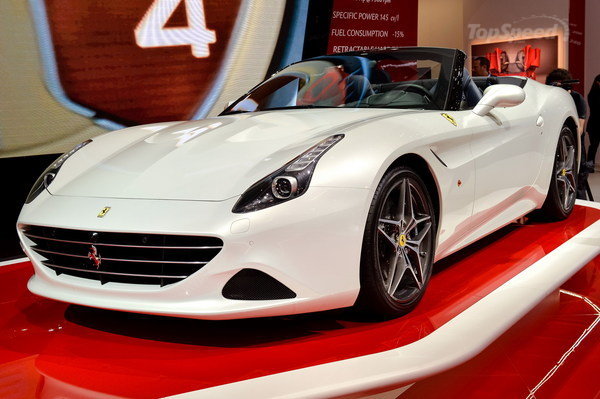
2015 Ferrari California T


Suntanned California has always been a place where people come to experiment with their identity. Thus, the name is perfect for Ferrari’s lowest-priced model, which has been an experiment since it first hit the streets in 2009. It was the first roadgoing Ferrari to put a V-8 in front of its driver and the first with a power-retractable hardtop, and its price and daily practicality took Ferrari on a low pass through the market. It probably should have been a Maserati, as it would have done far more to elevate that brand than it does for Ferrari, but the ball didn’t bounce that way.

Secretive Ferrari won’t say how the ­California sells, but judging by the pletho­ra of low-mileage examples parked on eBay with heavily depreciated prices, the market is perhaps lukewarm. The revamped ­California T—just 14 seconds turns this well-insulated hardtop coupe into a convertible—fixes what may have gone wrong with the old model, including a challenged power-to-weight ratio and styling that evoked a pouting teenager more than the snarling stallions of Maranello.


The T stands for turbo, of course, and in this regard the California, with its twin compressors hanging from a smaller 3.9-liter V-8 with a signature flat-plane crankshaft, is being experimental yet again. This is the first forced-induction street Ferrari since the F40, and so it is the pathfinder for the many turbocharged Ferraris to come, starting with the 488GTB, set to arrive early next year.

The new sheetmetal picks up themes from the F12berlinetta, replacing the soft roundness and elliptical headlights with Ferrari’s newer angular look. That includes more scalloping for ducts and vents, and the droopy black inset panel in back is gone and unlamented, as are the silly stacked pipes that helped heighten the car’s already-tall tush and give it a fake, forced showiness.

The new car’s sleeker form can’t hide the fact that it’s a big machine, being three full inches longer than a Chevy Corvette Stingray, as well as a bit wider, a bit taller, and way heavier at 4064 pounds. Even so, that’s 59 pounds lighter than our last California tester, and there’s 101 more horsepower and 199 more pound-feet of torque to motivate it. Hence, the 60-mph sprint plunges from 3.9 seconds to an astonishing (really, almost unbelievable) 3.3, with a full second knocked off the quarter-mile. And a 0.95-g skidpad perform­ance means there’s more grip to go with the extra kick.

Okay, so it’s finally Ferrari-fast. But a Ferrari has always been less about numbers than about being a crackling Tesla coil spitting lightning bolts. The new direct-injection V-8 barks into combustion, and it sounds every decibel the snarling, pissed-off puma that other Ferraris do. Hidden exhaust flaps somewhere under the car flutter as necessary to uncork and recork the growling on cue.


A Ferrari throttle has always given you precisely what you want, and the California T is, blessedly, no exception. Mat it to elicit the telltale wheeze of the turbos. As the boost builds to its 18.9-psi peak, the revs and power ramp up, but only with the slightest of kinks to the dyno trace. The redheaded V-8 delivers the goods with almost, if not quite, the organic smoothness of the Ferraris in Fangio’s day. It gathers speed in any gear and with haste ­proportionate to the pedal squeeze. The lag is short and glossed over, the V-8 just going when you ask it, exactly at the speed you ask of it. That bodes well for the 488GTB and turbocharged Ferraris yet to be born.

The California also stops with ferocity, but the standard carbon-ceramic brakes proved suppler at city speeds than others we’ve tried, behaving like iron brakes in all the best ways. With 47 percent of its weight on the front axle, the California T is rightly balanced and the steering reflects it, aiming the nose into corners with friction-free lubricity and a thrilling subtlety that matches the other controls.

The $5568 you must spend for Magnaride shocks on top of the California’s $202,723 base price is money well used. With it, the California feels as if it has yards of suspension travel over the bumps, yet restrains body roll and understeer when you’re hunting apexes. Here, again, everything is served in proportion to your demand, from steering angles to ride stiffness. One of the great joys in life is piloting this (or any other) Ferrari up a slithering road, top folded, the cylinders wailing an operatic octet as the red LED lights on the steering rim flicker. Voltage? This car produces it with uranium rods.

When you buy a Ferrari, you buy tradition expressed in aromatic panels of French-stitched leather, flat and rigidly firm bucket seats, and a familiar dashboard of simple circles augmented by a few conventional display screens. It’s definitely old school compared with, say, McLaren’s all-suede architectural cockpits, where the touch screens and buttons seem designed in the Infinite Loop. In the California T, a carbon-fiber arch dividing the center console, part of a $7761 carbon dress-up package, is the riskiest design flourish. The rest, from the large analog tach to the data screen next to it, is Ferrari convention.


It takes time, but eventually you appreciate the California’s practicality. Evoking its many years in the F1 coal mine, the busy steering wheel is where Ferrari puts all the old stalk controls. Using the turn signals is as simple as squeezing your palm, the wiper control reduced to a single multiaction button. The manettino knob gives you the choice of comfort, sport, and Mamma Mia mode, which switches off all the aids. A button marked “pit speed” seems a little precious in this, the Ferrari least likely to see a track. Thoughtfully, Ferrari lets you pick sport for the throttle and transmission settings but retain the softer shock setting if your roads aren’t smooth. Go forth and commute.

Unexpected conveniences: folding rear seats that reveal a tunnel into the large trunk for longer items; plenty of console clutter space; radio buttons on the backside of the steering wheel; a USB port. Typical (for an Italian car) inconveniences: the strange infotainment unit; poor radio reception; and a single 12-volt socket far from the windshield. Next year, Ferrari finally offers keyless operation, but for now you still get the vintage red-plastic-encased key that will suitably impress the valets.

Fanatics in red jackets may look down on it, and the option pricing gets silly (21 of its 28 available colors cost $12,486 extra), but the California T is more enthralling than its direct competitors, namely the Aston Martin DB9 and Bentley Continental GTC, and more passionate than the anodyne Porsche 911 Turbo S. It is your daily dose of Ferrari.

Thursday, November 12, 2015

2016 Nissan Maxima


What’s an automaker to do when customers abandon their mid-size sedans in hot pursuit of crossovers and pickups? The smart ones respond with irresistible crossovers and pickup trucks. The brilliant ones do the same without turning a cold shoulder to products they’ve nurtured for decades.

Case in point: Nissan’s new Maxima. With a nameplate that dates back to 1981 and 2.9 million U.S. sales thus far, the eighth-generation Maxima is a sports sedan with rousing performance, in-your-face design, and an interior capable of curing the most festering crossover urge. While other makers dump V-6s to add a hybrid powertrain or an all-wheel-drive option in their family sedans, Nissan is sticking to its Maxima guns with what it once again is touting as “the four-door sports car.”


That’s a stretch given the CVT living between the 300-hp 3.5-liter V-6 and the front wheels, but after a day’s drive near Nissan’s Nashville headquarters, we came away impressed by the effort bestowed upon the brand’s flagship. In spite of the gearless transmission, there’s plenty of fun and four-door utility available here for between $30,000 and $40,000.

The Details
The basic package is a touch longer (by 2.2 inches) and lower (by 1.3) but no wider. The 109.3-inch wheelbase and most of the unibody inevitably will be shared with the new Altima due soon. Thanks to more aluminum and high-strength steel, curb weight is a claimed 82 pounds leaner and torsional rigidity is 25 percent greater. Nissan builds the Maxima in Smyrna, Tennessee, in what it says is the highest-volume plant in North America. (Some 650,000 Altimas, Maximas, Pathfinders, Leafs, Rogues, and Infiniti QX60s are scheduled for this year, plus lithium-ion batteries for the Leaf.)

Most of the parts comprising Nissan’s venerable VQ35 3.5-liter V-6 are new, upping power a touch (to 300 horsepower at 6400 rpm, a 10-hp gain), without changing the torque peak of 261 lb-ft at 4400 rpm. Revisions include sodium-filled exhaust valves, reshaped intake valves, a more efficient intake manifold, and a stiffer oil pan. One notable omission is a move to direct fuel injection; Nissan is saving that worthwhile technology for its presumably more needy turbocharged engines. Engineers hoped EPA highway mileage would climb by 4 mpg to the enviable 30-mpg level, and the EPA has indeed certified the Maxima for 22 mpg city and 30 highway.


Thankfully, there has also been a full frontal attack to reduce the negative characteristics of the Maxima’s Xtronic CVT automatic supplied by Jatco. (Originally Japanese Automatic Transmission Company, it is three-quarters owned by Nissan, with Mitsubishi and Suzuki each having minor stakes.)

A 17-percent increase in the spread between the lowest and highest ratios is the main driver underlying the gain in highway fuel mileage. In addition, the CVT’s lubricating fluid is a thinner viscosity, there’s a smaller hydraulic pump, and the drive belt is a new higher-efficiency design.

2016 Mercedes-Benz GLE-class


When the Mercedes-Benz M-class was launched back in 1997, luxury SUVs were more of a “wait, what?” kind of thing than an idea whose time had come. Lincoln had just introduced the Navigator, while the Cadillac Escalade and the BMW X5 were still incubating. Range Rovers had been around, but here in the U.S., they were known less for their swagger than for their dismal reliability record. Luxury was a sedan thing. Who would want a luxury SUV?

Clearly, the Alabama-built M-class has proved a worthwhile endeavor, Mercedes-Benz boasting of some 1.6 million sold during the last 18 years. Now, the Mercedes SUV family has grown to include three more models, not to mention the long-serving and iconic G-class, prompting a new naming strategy to cut the acronym clutter. Hence, the M-class has become the GLE-class, the better to align it to a known sedan counterpart, the E-class. The swap coincides with the crossover’s midcycle refresh, which also sees it add a new plug-in hybrid and even a “coupe” counterpart (covered separately) to take on the BMW X6.

The exterior update is subtle yet effective. The edges have been sanded off most of the front-end elements, and the taillamps have been redesigned, bringing the whole vehicle more in line with the rest of the Benz family. The interior upgrade is rather more significant, primarily because the updated COMAND system places the control dial under a touch pad, à la 2015 C-class, while a large display screen stands prominently between two giant air vents. The rest of the dash and the door panels are unchanged, but between the new upper-dash components and the sumptuous materials, the cabin looks and feels more upscale than any M-class model’s ever did.

The GLE will be sold in no fewer than five versions in the U.S.—the gas-powered GLE350 and GLE400 models, the GLE300d, the new GLE550e plug-in hybrid (ZEV states only), and the stonkin’ 550- and 577-hp GLE63 AMG models. Unfortunately, our brief drive time through the Austrian mountains was limited to the GLE250d diesel (the name of the GLE300d in other markets) and the GLE550e plug-in hybrid.


A Familiar Diesel
Our initial impressions suggest that, as far as the diesel-powered GLE is concerned, everything we experienced when we tested the ML250 Bluetec a few months ago carries over. The torquey four-cylinder, which produces 201 horsepower and 369 lb-ft, feels quicker than the specs suggest—we saw an 8.3-second zero-to-60-mph time in our testing. All GLE models use a seven-speed automatic transmission, although a new nine-speed unit is available in the coupe.

The ride remains as pillowy as ever with the optional air suspension in comfort mode. Sport mode brings tidier body motions and a bit more communication from the chassis, although the steering remains slow off-center and aloof regardless of the setting. Relaxed as it is, we expect it will be perfectly aligned with most GLE buyers’ expectations; anyone in search of a more sporty luxury-ute experience will probably not even look at a GLE-class unless it wears “GLE63 AMG” badges on the back—that is, if they get past the Porsche store without driving off in a Cayenne.

The M-class always did surprisingly well off-road. But today’s model is even more capable, especially when equipped with knobby off-road tires and the optional On/Off-Road package (which in the U.S. will be offered only on the GLE400). It includes low-range gearing, locking differentials, added underbody protection, and a vehicle-raising function that adds more than an inch of ground clearance. The 360-degree parking cameras also come in rather handy when cresting a ridge without the aid of a spotter. Of course, the typical GLE-class will never see dirt beneath it, but it’s nice to know that, just in case Armageddon falls upon us, or a stalled truck blocks the entrance to Barneys, one can hop a curb and trample the impatiens with aplomb.


A New PHEV
At roughly 5400 pounds, the GLE550e 4MATIC plug-in hybrid is a lot porkier than the GLE300d, but with 436 horsepower and 479 lb-ft of torque from its combo of a 329-hp V-6 and 114-hp electric motor, it’s much faster. Mercedes estimates a zero-to-62-mph time of 5.3 seconds, which compares rather favorably to Porsche’s 5.4-second estimate of its 416-hp Cayenne S E-Hybrid’s zero-to-60 sprint. Rather more to the point is the hybrid’s ability to travel some 19 miles at speeds up to 81 mph purely on electrons. When left in its default hybrid mode—one of four powertrain settings that also include E-Save, Charge, and electric-only modes—we found that the vehicle cruises along using battery power nearly all of the time, with the gas engine slipping into and out of the picture with the subtlety of a jewel thief. Insofar as silent speed is consistent with luxury—and Tesla has certainly proved that it is—the GLE550e feels pretty spot-on. Consider this a preemptive strike against the Model X.

The bulk of the GLE-class lineup arrives in showrooms in August, at prices ranging from $52,025 to $65,525 for non-AMG versions. (AMG models ring in at $100,875 for the GLE63 AMG and $108,025 for the S model; more pricing info for the lineup can be found here.) We’re still awaiting prices for the plug-in hybrid, which arrives in September, but we’ve been advised, “It won’t be cheap.”

Despite the new name, Mercedes is not really blazing a new trail with the GLE-class, but with an improved interior and a broader model range, it is better able to cover the wide spectrum of the segment it helped create.

2016 Lamborghini Aventador LP750-4 SV


That’s what we were promised by, of all things, a PowerPoint slide during the presentation of the new 2016 Lamborghini Aventador SV as we geared up for some lap time at Spain’s Circuit de Barcelona-Catalunya. It’s not often we see “crazy,” with all it implies, during a press presentation, especially by a company hocking its own product, but there it was.

Lamborghini wasn’t calling the whole car crazy, only the acceleration, but it might as well have been. First off, the SV (which stands for “Superveloce,” or “superfast”) packs the same tune for its V-12 as did the hyperexpensive, only-three-were-sold-to-the-public Veneno. It’s Lambo’s most powerful V-12, and it leverages optimized variable valve timing, a new exhaust system, and a higher redline (now 8500 rpm, up from 8350) to raise output to 740 horsepower at 8400 rpm. Torque remains at the same level as in the non-SV Aventador: 509 lb-ft at 5500 rpm. But while the dorsal-finned Veneno’s calling card was its crazy styling, the Superveloce is intended solely to circle a racetrack as quickly as possible. Which it does, having just lapped the Nürburgring in less than seven minutes. Only a “crazy” car can do that.

Helping matters is the claimed weight loss of 110 pounds. That comes courtesy of composite rear fenders and rocker panels, as well as a manually adjustable carbon-fiber wing and fixed C-pillar aero scoops in place of the electronically actuated wing and scoops on the standard Aventador. There’s also much less sound insulation and carpeting (leaving the sexy carbon-fiber structure largely exposed), plus thinly padded fixed-back carbon-fiber racing seats. Other consequential changes include the fitment of lightweight (and gorgeous) new wheels, lateral strut-type magnetic shocks (a production-car first, says Lamborghini), and variable-ratio steering that reduces lock-to-lock motion, particularly with the drive systems in the most aggressive mode, Corsa.


During our laps on the circuit, the first thing we noticed was the sound, carefully engineered to let in the harmonics of the engine but not the less-desirable transmission chatter. The result is a raw, wicked wail that easily drowned out the directions we were being given over an in-car radio issued by Lamborghini.

Lamborghini test pilota Marco Passerini led us around the track, and he wasn’t shy as a driver (or a person), quickly establishing a rapid pace through Catalunya’s 16 corners. Thanks to the SV’s brilliant Haldex-based all-wheel-drive system and bespoke Pirelli rubber—10 inches wide up front, 14 (!) out back—we didn’t feel the need to be shy, either. Grip is everywhere, and, yes, acceleration is absolutely ballistic. Connecting the turns with full-throttle bursts, we were pinned to the seats; by taking each gear all the way to redline, we regularly saw speeds just below 170 mph at the end of the front straight, usually lifting before the braking point lest we get too up close and personal with Passerini’s (slightly) slower, regular-grade Aventador.

Such explosive acceleration means that corners come up, ahem, super fast. More than once we found ourselves charging into a corner so rapidly we felt sure we were toast, but standing on the massive carbon-ceramic brakes yanked the car down reliably so we could hit our turn-in marks and carve across the apex.

Some credit for the stupefying abilities demonstrated by the car can be issued to the astounding high-speed downforce—up by 170 percent, says Lamborghini—which helps keep those fat Pirellis adhered to the pavement during such pucker-inducing braking. As if to prove the point, we watched the rear of Passerini’s car dance around under full brakes while the rear of our car stayed put.


It took a few corners, however, to get used to the new variable-ratio steering. Between the right-now braking, the proactive magnetic dampers keeping things flat, and the extremely quick steering in Corsa mode, turn-in is so immediate that our first laps included making many minor midcorner corrections. We also toggled between Sport and Corsa modes, finding Sport to be amazing in its own right, but we liked the latter even more once we became acclimated to the steering. Corsa also offers hyperspeed shift times and a more textured ride quality than do the slightly softer Sport and softer-still Strada modes.

Back in the pits, we exited the car with a sort of wonder and appreciation for the world—the violence and rawness of the experience had us feeling like we’d had multiple near-death experiences in the span of 10 minutes. Even after multiple sessions, our internal dialogue remained the same: First: “I’m alive.” Second: “What an awesome car.” Third: “My brain might explode, that was so incredible.”

As is the case with most sports cars, lower mass means better performance. Lower mass also usually means more money, and in Lamborghini terms, the cost is precisely $88,400 more than the non-SV model. Bespoke treatments will jack up the price even more, and only 600 SVs will be built. According to several Lamborghini officials present—including CEO Stephan Winkelmann—a future Aventador SV roadster is “possible.” Wink. Nod. Grin. Got it. Figure on a price point about $50K higher, and about 100 pounds of weight added back in. Might that make it slower? It could. Would it still be crazy? You’re damn skippy.

2015 Lamborghini Huracán LP610-4


You may know the Nardò Ring as the 7.8-mile asphalt track where the world’s automakers take their top-speed vacations. A traffic-free circular autobahn in the heel of Italy’s boot, the Porsche-owned test track is banked such that you can take your hands off any car’s steering wheel at 149 mph in the outer lane. It’s one of the few places on the planet where Lamborghini’s new 10-cylinder wedge, the Huracán, could prove to us how aerodynamically sound it is approaching its claimed top speed of 202 mph.

We say “could” because the ring is off-limits today. Instead, we’re rifling through Nardò’s other treasure, a 3.9-mile squiggle of asphalt known only as the handling track. Wide enough to field a NASCAR race and technical enough for a Grand Prix, it merits a more pretentious name, so we’ll give it one.


Circuito Internationale Nardò, as we’ll call it, is 16 corners of sweepers, hairpins, and flyers that make it a perfect place to inspect Lamborghini’s new runt and its 602-hp, anything-but-runty V-10. Halfway around the track, you crest a small rise that reveals a heart-stopping panorama stretching to the horizon. The land falls all the way to the Ionian Sea, creating the illusion that a wrong move could send the Huracán sliding nearly two miles into the drink.

A car with this much drama and this much speed doesn’t let your pulse rest for long. The Huracán corners flat, grips doggedly, and blitzes out of bends. But it keeps your heart rate from fully redlining by being just as precise and predictable as it is explosive. There’s more understeer in this four-wheel-drive Huracán than elsewhere in the mid-engine stratum, but it’s hardly the frightening push of some past Lambos. Trail the brakes or lift in a corner and the aluminum-and-carbon-fiber space frame willingly changes direction. The brakes bite ­progressively, with some of the best modulation we’ve experienced from carbon-ceramic discs. Pirelli P Zero rubber sinks claws into the pavement to produce ­cornering grip of 1.01 g’s and a 70-to-0-mph stopping distance of just 144 feet. The seven-speed dual-clutch automatic, Lam­bor­ghini’s first such transmission, executes ruthless, premeditated gear­changes. You don’t miss turbochargers when you have 10 ­cylinders inflating a torque curve to such a healthy level, either.


According to our tests, the baby Lambo is quicker than not just the Ferrari 458 Italia but also its big brother, Lambo's Aventador.
Lamborghinis once had a reputation for being fast in a straight line and clunky in corners. This car is fast everywhere, though our test gear confirmed that this Huracán is freakishly quick in a straight line. We ripped to 60 mph in 2.5 seconds and burst through the quarter-mile in 10.4 seconds at 135 mph. Forget the comparable Ferraris and McLarens—they’re eating the Huracán’s dust. In fact, the little Lambo even knocks off the Porsche 911 Turbo S, a computerized acceleration kill-bot and another bright satellite in the VW universe. This thing is Veyron quick.

But the real drama lies closer to home as the Huracán, base price of $241,945, beats the $404,195 Lamborghini Aventador in the critical acceleration measures by a half-second. You still have to buy the expensive one, however, if you want doors that open up rather than out. Seems worth it, no?


Our Huracán demands a break after 55 miles of Nardò’s handling track. The water-temperature needle nips at the red, and the digital instrument cluster begs us to have mercy on the transmission. When a cool-down lap yields no relief, we pit. The 5.2-liter decachord behind the seats snorts steam through its air intakes and the slatted engine cover, enveloping the rear half of the car in a sweet-smelling ethylene-glycol fog.

The popular story line holds that the newest bulls mark a monumental shift for Lamborghini and its relationship with Audi; that the Germans have gone down to where the wild things are and tamed one and made it their own. The blown coolant hose is only the first indication that this Lamborghini is still very much Italian.

Another Huracán—color-matched and identically equipped for just such a contingency—appears for us just as our allotted track time expires. We head south, following the sapphire sea where it laps postcard beaches, the wild, natural beauty a stark contrast to ugly clusters of seemingly abandoned, half-finished homes. The construction is largely unpermitted, says Lambo press boss Raffaello Porro, with structures built in phases as the owners accrue the necessary funds. Scrappy, rules-be-damned solipsism is emblematic of the “mental anarchy and individuality of Italians,” he says.

Was he talking about houses or Lamborghinis? Even as Sant’Agata explores refinement and subtlety with Audi’s cash, the Huracán is still all angles and ostentation, a 10-cylinder thunderhead crackling across the landscape with snap-bang upshifts, extravagant ergonomics, and superlegal capabilities. It’s still loud, fast, and violent. It’s still anarchy.


Italian individualism explains how Ferrari can reside just 25 miles away and develop radically different answers to the same questions. The Huracán doesn’t have the finesse of a 458 Italia, but then the Ferrari doesn’t have the Lamborghini’s outsized personality.

While Audi’s four rings are cast into the suspension members, the Lamborghini has far less compliance than an R8. As with the Aventador, the Huracán’s suspension travel feels as if it’s measured in a scant few millimeters. Holding the weight to just 3423 pounds means our test car was light on optional equipment; no magnetorheological dampers to smooth the swells in the road. Limestone brick roads such as those in the quaint medieval downtown of Gallipoli are hard on the car and harder on the driver. The fixed-back, carbon-shell sport seat (a late-availability option in the U.S.) forces you into an upright position that suggests the seat is perched higher than it is. The navigation and audio equipment is Audi MMI–spec, but the display is rendered at half the usual size and plopped in the lower-right corner of the digital instrument cluster, making it difficult to read.


The biggest nod to sensibility is the new dual-clutch transmission. You already know it as the S tronic gearbox in the Audi R8, but here it’s called Lamborghini Doppia Frizione. When the Aventador arrived in 2012, Lamborghini touted its antiquated single-clutch transmission as “the world’s most emotional gear shift,” a rosy euphemism for gaping torque holes, abrupt shifts, and erratic low-speed behavior.

The dual-clutch cures all that, juggling seven closely spaced ratios with flawless logic. As you toggle the steering-wheel-mounted “ANIMA,” or mode selector, from strada to sport, gearchanges quicken and intensify until, in corsa mode, full-throttle upshifts cause your head to bounce off the seatback. The engine’s timbre gets angrier and the steering grows heavy. Launch control ratchets the V-10 to 4200 rpm before ruthlessly dropping the clutch. The Huracán will upshift automatically at redline, but not before running into the limiter for a fraction of a second. Using the paddles to call for earlier shifts knocks a tenth, sometimes two tenths, off the figures.

That’s a reassuring feeling—the notion that Lamborghini might favor a brutal shift over a faster one. It’s confirmation that the company hasn’t lost sight of what sets it apart: a touch of rawness. Spectacular as they are, the Ferrari 458 Italia and McLaren 650S don’t need to be copied. The fewer concessions to drivability found in the Huracán’s katana-sharp handling, scorching acceleration, and—since we’re obliged to take Lamborghini’s word for it—202-mph top speed only make the car that much more alive.

Wednesday, November 11, 2015

2015 Ferrari 458


The “A” in the new Ferrari 458 Speciale A’s name doesn’t stand for “awesome,” but it could. The “A” actually is for Aperta, the Italian word for “open.” Based, of course, on the 458 Italia, this version of the 458 Spider gets the same special upgrades as the transcendent Speciale coupe.

That means 597 horsepower and 398 lb-ft of torque from the naturally aspirated 4.5-liter V-8—it hasn’t gone turbocharged yet—making it the most powerful spider ever to emerge from Maranello. The power increase comes courtesy of a 14:1 compression ratio, a new manifold and airbox rendered from carbon fiber, higher lift for both the intake and exhaust valves, new pistons, and reworked intake runners and ports. The gearbox is a revised seven-speed dual-clutch automatic with shifts so quick that they could bend both space and time.


The Speciale A sports an aluminum lid that retracts or raises in just 14 seconds; the price paid for the deployable roof is 110 additional pounds to cart around. Even so, Ferrari estimates that the car will rocket to 62 mph in three seconds flat, but we’d likely be able to break into the twos in a 0-to-60 run with our equipment aboard.

Other carry-overs ported from the fixed-top Speciale include Side Slip Angle Control, the lines of code for which were developed in part for the LaFerrari mega-ultra-hypercar. It aims to measure the car’s slip angle in real time, then adjust the electronic rear differential and stability control based on what it determines to be the optimum slip angle. (Learn more about how it works, as well as myriad suspension, steering, and other chassis upgrades, in our 458 Speciale first drive.)


The A also gets the 458 Speciale’s advanced aerodynamic features, including a flap ahead of the front fascia’s Ferrari logo that sends air under the car to create more rear downforce at high speeds. Spring-loaded doors up front open above 105 mph to divert air from the radiators and through vanes at the corners of the car. The regular Spider’s three-tip central exhaust becomes a pair of wider-set cannons to accommodate a big rear diffuser and a motor-actuated drag-reduction setup that drop from the underside of the rear end to help achieve Vmax. The coupe can hit 202 mph; no figure has been released yet for the A.

The car makes its debut at the 2014 Paris auto show, and just 499 will be built. We’re guessing a big-ol’ chunk of the run has already been spoken for.